

Toronto’s Real estate market favours buyers in condos, with GTA benchmark prices at $917,600, down 4.7% year-over-year. Detached homes trend toward sellers as inventory drops. You should compare building, neighbourhood, and recent sales before entering. Toronto Condo Team provides local expertise across 600+ buildings to guide your purchase.
Key Takeaways
GTA benchmark home prices fell 4.7% year-over-year to $917,600 in September 2026.
Condo apartments absorbed the steepest correction, creating a measurable entry point for buyers.
Detached home prices dropped 4.9% to $1.29 million, though three-month trends show increases.
Inventory levels dropped year-over-year, shifting detached homes toward seller-favoured momentum.
What is driving Toronto’s current market shift?
Toronto’s housing market is shifting as prices retreat from recent peaks. The Greater Toronto Area’s benchmark home price reached $917,600 in September 2026, marking a 4.7% year-over-year decline according to WOWA’s October 2026 market update. The average sale price fell 5.1% to $1,006,409 over the same period. These numbers signal a market where buyers hold more leverage than they did twelve months ago.
What changed? Supply and demand dynamics have tilted. Inventory levels across the GTA have dropped compared to last year. Purchase demand has not kept pace with earlier expectations. Fewer buyers are competing for available properties. Sellers who priced aggressively in 2024 and early 2025 now face longer listing periods and downward pressure on final sale prices.
Why are Toronto home prices declining right now?
Higher borrowing costs continue to weigh on buyer budgets. Mortgage qualification remains tighter than during the low-rate years, reducing the pool of buyers who can transact at current price levels. At the same time, some sellers are adjusting expectations after watching comparable listings sit on the market. The result is a gradual price correction rather than a sudden drop.
Which Toronto property types are seeing the biggest price changes?
Detached homes recorded a 4.9% year-over-year average price decrease to $1.29 million. Semi-detached properties held steady at $1.02 million, showing relative resilience. Condo apartments, which represent a large share of Toronto transactions, also posted declines. For buyers and investors tracking Toronto Real Estate Market Trends, the variation across housing types matters. A detached home in North York behaves differently than a downtown condo. rising rental costs add another layer to the investment calculation.
Toronto Condo Team brings more than 25 years of experience across condominiums, lofts, homes, and investment properties. Understanding which segments are softening and which are holding value helps you time a purchase or sale with greater confidence. The current shift rewards patience and precise property selection.
How have condo prices performed recently?
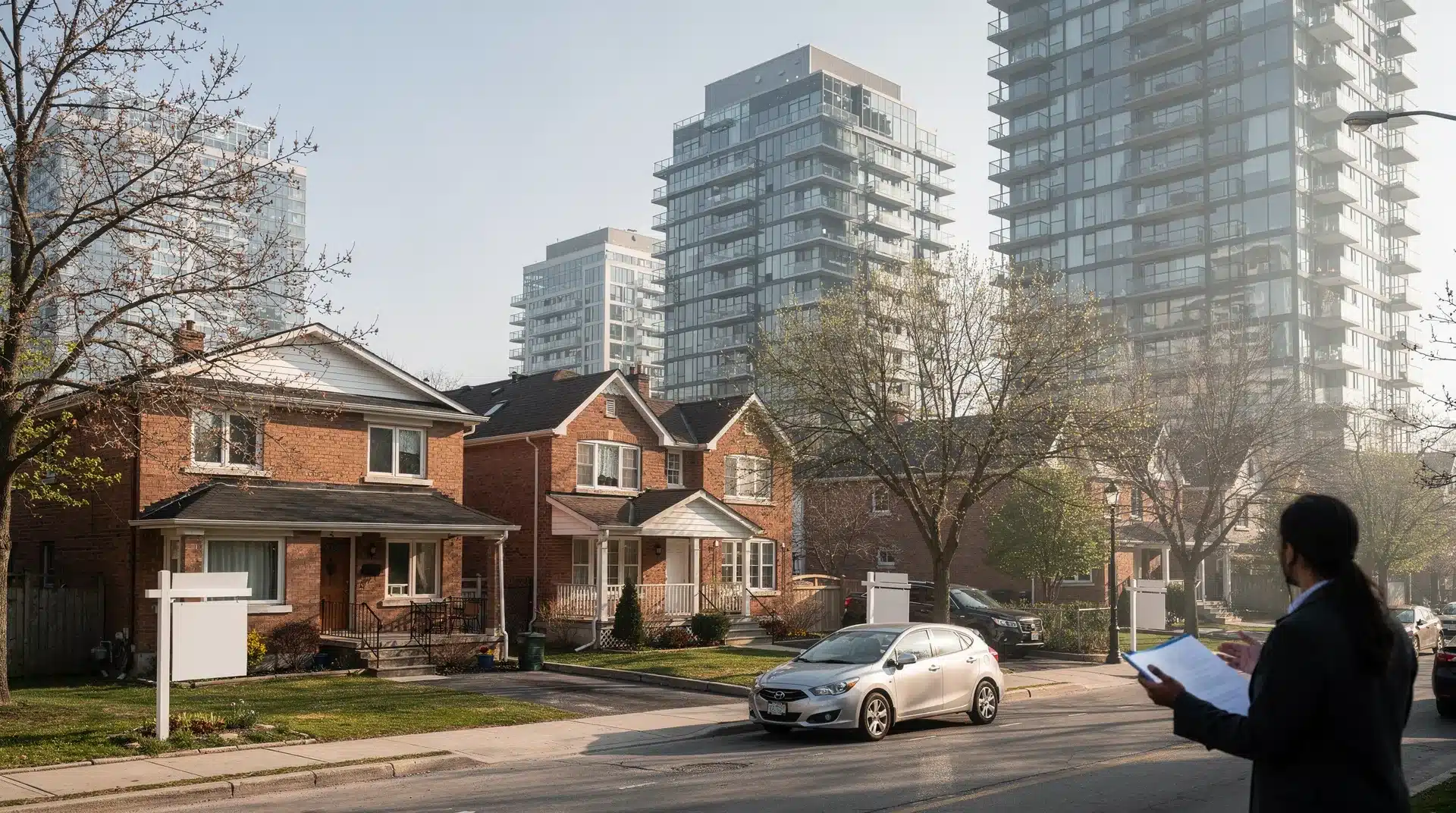
Toronto condo apartment prices fell year-over-year, according to WOWA’s September 2026 market update. That decline creates a measurable opening for buyers who were priced out during the 2022 peak. Sellers face a different reality: listing without a sharp pricing strategy risks extended days on market and compounding carrying costs.
The shift matters because Toronto Real Estate Market Trends now diverge sharply by housing type. Detached homes held firmer, while condo apartments absorbed the steepest correction. For you as a buyer or investor, that spread changes the math on entry points, rental yields, and resale timelines.
What does a price drop mean for buyers?
Lower prices reduce your down payment requirement and monthly mortgage exposure. But the discount also signals weaker near-term appreciation, so your holding period needs to stretch beyond a quick flip.
Should sellers wait for condo prices to recover?
Waiting carries real cost. Every month of holding a vacant or underperforming unit adds maintenance fees, property taxes, and mortgage interest. A year-over-year decline means a unit priced at last year’s comparable sits unsold while competing listings undercut it. Pricing to current comparables, not past expectations, shortens exposure.
Toronto Condo Team has been involved in 1,000+ condominium units and represents buyers and sellers across more than 600 Toronto resale condominium buildings. The team works with both end-user buyers and real estate investors purchasing resale and new construction properties throughout Toronto and the Greater Toronto Area. That building-level experience helps you separate genuinely discounted units from buildings with structural issues behind the price drop.
Review condo pricing trends before making an offer. The current market rewards buyers who understand why a specific building’s average fell, not just that the citywide number dropped.

What is happening with detached house prices?
Toronto’s detached home average price fell 4.9% year-over-year to $1.29 million, according to WOWA’s October 2026 market update. That decline creates a measurable entry advantage for buyers who were priced out twelve months ago. Without acting on this window, you risk watching your purchasing power erode as conditions shift.
The detached house market currently sits in balanced territory. Buyers and sellers hold equal negotiating power, though the momentum favours sellers. Inventory levels have dropped compared to last year. Fewer active listings mean less choice for you, and rising purchase demand tightens the supply further.
Why are detached prices down year-over-year but conditions improving for sellers?
Short-term trends tell a different story than the annual figure. Over the past three months, both benchmark and median detached house prices increased. That upward movement benefits sellers right now. Yet prices remain lower than one year ago, which keeps buyers in a stronger position on an annual basis. The market is transitioning, and the balance is fragile.
Should you buy a detached home in Toronto while prices are lower?
A purchase decision depends on your timeline and financing. Lower year-over-year prices reduce your upfront cost. Shrinking inventory, however, means competition for well-priced detached homes is intensifying. Toronto Real Estate Market Trends point toward a seller-favoured shift. Waiting could mean paying more later and facing fewer options.
Toronto Condo Team brings more than two decades of experience representing buyers and sellers of detached homes, semi-detached homes, townhomes, and multimillion-dollar freehold properties across the city. That local knowledge helps you evaluate whether today’s $1.29 million average aligns with your long-term goals.

Are semi-detached and townhouse prices stable?
Semi-detached home prices held steady year-over-year at $1.02 million. These two segments tell different stories for buyers and investors watching Toronto Real Estate Market Trends.
Stability in one category and decline in another create distinct entry points. A flat semi-detached price signals balanced demand. A 4.2% drop in freehold townhouse values points to softer buyer competition.
What does a flat semi-detached price mean for buyers?
A year-over-year price of $1.02 million with zero change suggests sellers are holding firm. You face less urgency to bid aggressively, but inventory may be tighter. Semi-detached homes in neighbourhoods like Leslieville, Riverdale, and Midtown Toronto often attract end-users who value land and location over short-term price movement.
Why did freehold townhouse prices drop?
More supply or cautious buyer sentiment can push prices down. For investors, this creates a potential value opportunity. For end-users, lower prices improve affordability in markets like North York, Liberty Village, and the Distillery District.
Which Toronto neighbourhoods offer the best value right now?
Neighbourhood choice depends on your goal. Semi-detached buyers often target established residential pockets with strong school catchments. Townhouse buyers may find better pricing in areas with newer developments or higher inventory. Toronto Condo Team works across major markets including Downtown Toronto, Yorkville, King West, the Toronto Waterfront, CityPlace, the Financial District, the Entertainment District, St. Lawrence Market, Queen West, and Fort York.
Price stability in semi-detached homes rewards patience. A 4.2% townhouse discount rewards decisiveness. Your strategy should match the segment you are targeting.
Where do buyers have negotiating leverage right now?
Buyers hold the strongest negotiating position in Toronto’s condo apartment segment. WOWA’s September 2026 market update shows condo apartment average prices fell year-over-year, the steepest decline among all housing types in the Greater Toronto Area. That gap between seller expectations and actual sale prices creates real room to negotiate.
The broader Toronto Real Estate Market Trends tell a similar story. The average home sold price across the GTA decreased 5.1% year-over-year to $1,006,409 for September 2026, according to WOWA. Sellers who priced for last year’s market now face longer listing periods and fewer competing offers.
Which Toronto property types give buyers the most leverage?
Condo apartments: The largest price correction, and the most negotiable segment.
Detached homes: Down 4.9% year-over-year to $1.29 million. Balanced conditions, but trending toward sellers.
Moderate buyer advantage.
Semi-detached homes: Unchanged year-over-year at $1.02 million. Tightest segment for buyers.
How should you approach negotiations in a declining market?
Start with recent comparable sales from the last 30 days, not spring 2026 pricing. Sellers anchoring to older numbers lose deals when buyers present current data. Toronto Condo Team has reported more than $300 million in real estate sales and served hundreds of buyers and sellers, which means the team sees which buildings and neighbourhoods are actually moving.
You also need the right professionals behind you. Toronto Condo Team’s service model connects buyers with mortgage professionals, real estate lawyers, home stagers, and renovators. That network matters when you are negotiating repairs, financing conditions, or closing dates. For a closer look at how downtown condo conditions are shifting, review what is happening in Toronto’s downtown condo market before you make an offer.
What should investors consider for cash flow?
Cash flow in Toronto’s condo market starts with the purchase price. The average condo apartment price dropped year-over-year, according to WOWA’s October 2026 market update. Lower entry prices improve your monthly spread between rental income and carrying costs. That spread disappears fast when you overpay.
Monthly expenses make or break your return. Condo fees, property taxes, mortgage payments, and insurance all subtract from gross rent. A unit that looks affordable on paper can turn cash-flow negative if the maintenance fees climb faster than rent growth. You need to model these numbers before submitting an offer.
Which Toronto condo buildings deliver the strongest cash flow?
Not all buildings perform equally. Older concrete structures often carry higher monthly fees that erode net income. Newer glass towers in neighbourhoods like CityPlace or Liberty Village sometimes offer lower fees but face steeper competition from other investor-owned units. The right building balances purchase price, fee structure, and tenant demand.
How do pre-construction condos affect cash flow timing?
Pre-construction purchases delay cash flow by years. You commit capital today but collect no rent until occupancy. During that gap, market rents and interest rates can shift. Investors who buy pre-construction need a buffer for carrying costs. A realistic projection of future rental rates in the specific Toronto submarket.
Toronto Real Estate Market Trends now favour investors who target resale units with immediate rental potential. Falling prices create entry points that were unavailable 18 months ago. Toronto Condo Team has worked across more than 600 resale buildings and hundreds of new developments, giving investors access to comparable data on fees, rents, and price-per-square-foot across the city. The team’s experience with both end-user buyers and real estate investors means your property search filters for cash flow from day one. Investment real estate, condo rentals, and pre-construction analysis all fall within the team’s primary areas of expertise throughout Toronto and the Greater Toronto Area.
How do interest rates affect Toronto real estate?
Higher interest rates reduce what you can borrow. That single shift reshapes your buying power, your monthly carrying costs, and the price you can offer on a Toronto condo or home. When rates climb, the same mortgage payment buys less property. Sellers who ignore this reality watch their listings sit.
The math is straightforward. A one-percentage-point rate increase cuts your maximum mortgage amount. For a Toronto buyer targeting a $1 million property, that loss of leverage can push entire neighbourhoods out of reach. The Toronto Real Estate Market Trends data from September 2026 confirms the pressure. WOWA reports the Greater Toronto Area benchmark home price fell to $917,600, a 4.7% year-over-year decline. The average GTA home sold price dropped 5.1% to $1,006,409 over the same period.
What happens to condo prices when rates stay high?
Condo apartments feel rate sensitivity first. Entry-level buyers and investors dominate this segment, and both groups depend heavily on mortgage financing. When monthly costs rise, demand softens. Prices adjust downward. You see this pattern across downtown Toronto, where investor-owned units compete for fewer qualified buyers.
Should you buy now or wait for lower rates?
Waiting carries its own risk. Prices can firm up quickly once rates decline, and competition returns fast. Toronto Condo Team combines more than 25 years of Toronto real estate experience with deep condominium, building, neighbourhood, new development, home and luxury market expertise. Clients also gain access to a coordinated professional network that can support financing, legal services, staging, design, renovations, property preparation and other aspects of the buying and selling process. The right move depends on your timeline, your down payment, and the specific building or neighbourhood you are targeting.
What is the outlook for Toronto real estate through 2027?
Toronto’s housing market is shifting toward a more predictable cycle. Policymakers appear to guide the market toward annual price growth that aligns with income growth. This signals a departure from the rapid appreciation of recent years. For buyers and investors, the outlook through 2027 centres on normalization rather than speculation.
What does price growth tied to incomes mean for buyers?
Steadier, income-linked appreciation changes the math for end users. You lose the urgency of chasing runaway prices. Instead, your purchase decision can focus on long-term suitability. Monthly carrying costs and neighbourhood fit become more important than short-term equity spikes.
How are pre-construction buyers affected by recent price declines?
Declining new home prices create a specific risk for buyers who signed pre-sale contracts after 2021. Those purchasers may end up paying significantly more than recent buyers in the same development. This gap erodes equity before occupancy even begins. Investors holding these contracts face a difficult choice between closing at an above-market price or walking away from their deposit.
The detached segment shows balanced conditions, though inventory has dropped compared to last year. Purchase demand has risen while active listings have decreased. Benchmark and median detached prices increased over the past three months. Yet prices remain lower than one year ago, giving buyers an annual advantage.
Toronto Real Estate Market Trends point to a market where timing and asset selection matter more than broad momentum. Condominium buyers and investors should compare resale values against new construction pricing carefully. The gap between contract prices and current market values demands scrutiny. Working with a team that tracks both resale condominiums and new developments across Toronto helps you avoid overpaying in a normalizing market.
FAQ
Why are Toronto home prices declining right now?
Higher borrowing costs tighten mortgage qualification, reducing buyer competition. Sellers adjust expectations after comparable listings sit longer, creating a gradual price correction.
How have condo prices performed recently?
Condo apartment prices fell year-over-year, creating a measurable entry point for buyers priced out during the 2022 peak. Sellers without sharp pricing risk extended days on market.
Conclusion
Toronto’s market now rewards buyers who compare resale values against new construction pricing and who prioritize immediate rental potential over speculative appreciation. The path forward favours those who act on current data rather than waiting for a return to 2022 conditions. Your next step is to evaluate specific buildings and neighbourhoods against your timeline and carrying costs, then move when the numbers support your decision.